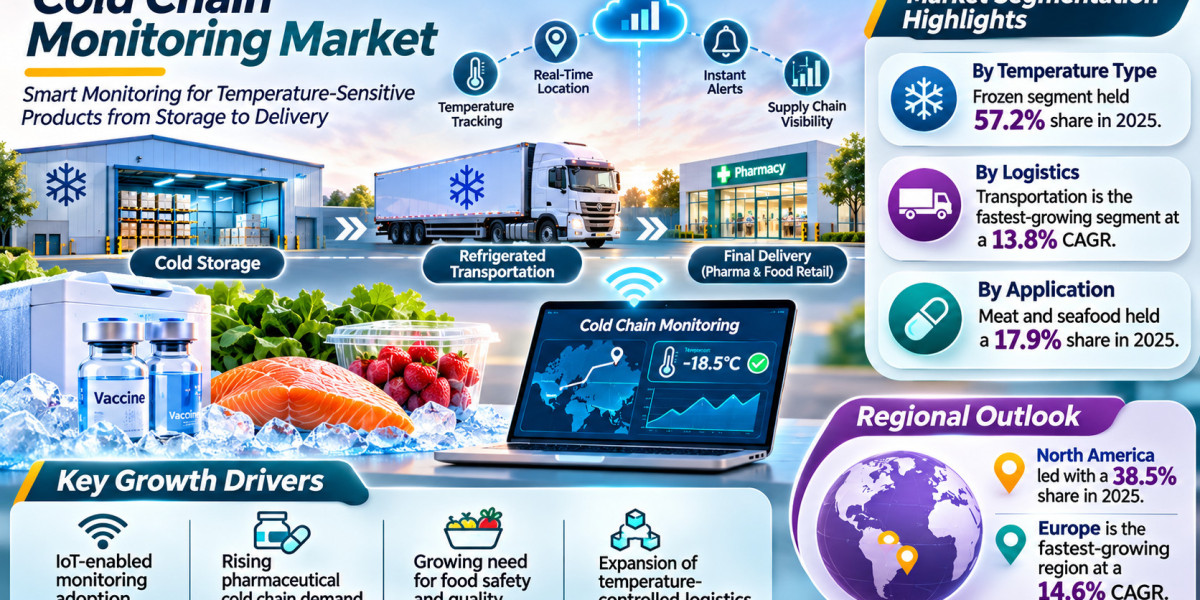

Cold chain monitoring is becoming increasingly important as global supply chains handle larger volumes of temperature-sensitive food, pharmaceuticals, vaccines, biologics, and other perishable products. Connected sensors, GPS tracking, cloud platforms, and automated monitoring systems help businesses maintain suitable storage and transportation conditions while improving shipment visibility. The growing need to reduce product spoilage, strengthen pharmaceutical distribution, and maintain food quality is creating new opportunities for cold chain monitoring technology providers.
According to Straits Research, the global cold chain monitoring market was valued at USD 8.64 billion in 2025 and is projected to grow from USD 9.78 billion in 2026 to USD 26.37 billion by 2034, registering a CAGR of 13.2% during the forecast period (2026–2034). North America dominated the market with a 38.5% share in 2025, supported by established refrigerated logistics infrastructure, pharmaceutical distribution, and demand for temperature-controlled food transportation.
IoT-Enabled Monitoring Strengthens Cold Chain Visibility
The integration of Internet of Things (IoT) technology is transforming traditional cold chain operations through continuous temperature, humidity, and location monitoring. Connected sensors transmit real-time information to cloud-based platforms, allowing logistics operators to identify temperature deviations, equipment failures, and shipment delays. Automated alerts and centralized monitoring dashboards help businesses respond quickly to potential disruptions, improving product traceability and supply chain visibility. The growing international trade of perishable food and pharmaceutical products is further encouraging investment in connected monitoring solutions.
Temperature-Sensitive Pharmaceutical Distribution Drives Adoption
The expanding distribution of vaccines, biologics, insulin, blood products, and specialty medicines is increasing the importance of reliable cold chain monitoring. These products require controlled environmental conditions throughout storage and transportation because temperature fluctuations can compromise product quality and effectiveness. Continuous monitoring systems provide pharmaceutical companies and logistics operators with better control over shipment conditions through connected sensors, GPS tracking, and automated notifications. Increasing pharmaceutical distribution and the complexity of healthcare supply chains are therefore supporting technology adoption.
Market Segmentation Highlights
The cold chain monitoring market is segmented by temperature type, logistics, and application.
By temperature type, the frozen segment dominated the market with a 57.2% share in 2025. Frozen monitoring solutions are widely used for meat, seafood, processed foods, frozen fruits, and vegetables that require consistently low temperatures during storage and transportation. The chilled segment also represents an important category, serving fresh produce, dairy products, fresh meat, seafood, and pharmaceutical applications.
By logistics, transportation is the fastest-growing segment, projected to register a CAGR of 13.8% during 2026–2034. The expansion of international trade in perishable foods, biologics, and temperature-sensitive medicines is increasing demand for refrigerated trucks, containers, and connected transportation systems. Real-time monitoring helps logistics operators maintain shipment conditions during long-distance movement.
By application, meat and seafood held the largest market share of 17.9% in 2025. The highly perishable nature of these products makes continuous temperature monitoring essential for preserving freshness, safety, and quality. Other applications include fruits and vegetables, fruit pulp and concentrates, dairy products, fish, processed food, pharmaceuticals, and bakery and confectionery products.
Regional Outlook: North America Leads as Europe Accelerates
North America dominated the cold chain monitoring market with a 38.5% share in 2025, reaching a market value of USD 3.33 billion. Established refrigerated storage and transportation networks, strong demand for fresh and frozen foods, and expanding pharmaceutical distribution support regional growth. The United States accounted for approximately USD 2.83 billion of the regional market in 2025.
Europe is the fastest-growing regional market, with a projected CAGR of 14.6% during 2026–2034. Increasing demand for fresh food products, pharmaceutical cold chain services, stringent food safety requirements, and investments in advanced refrigerated logistics are supporting expansion. Germany and the United Kingdom remain important markets for temperature-controlled distribution and connected monitoring technologies.
Asia Pacific accounted for 23.4% of the market in 2025, reaching USD 2.02 billion. Rapid urbanization, rising consumption of frozen foods and seafood, expanding pharmaceutical manufacturing, and investments in refrigerated warehouses are supporting regional demand. China and Japan are among the important markets contributing to the development of temperature-controlled supply chains.
Competitive Landscape and Industry Developments
The competitive landscape includes technology providers specializing in temperature sensors, connected monitoring devices, shipment tracking, and cloud-based supply chain visibility. Key companies identified by Straits Research include ORBCOMM, Sensitech, Elpro-Buchs, Berlinger & Co., and Monnit.
Recent industry developments highlight the growing integration of IoT, artificial intelligence, and predictive analytics into cold chain operations. In May 2026, Emerson expanded its cold chain monitoring solutions with AI-powered temperature tracking and cloud-based visibility platforms. In March 2026, Carrier Global introduced advanced monitoring technologies featuring IoT-enabled sensors, real-time data analytics, and remote asset management. In October 2025, Sensitech expanded its TempTale monitoring portfolio with connected devices offering improved tracking and compliance support. In June 2025, Tive introduced enhanced IoT-based solutions combining real-time location tracking and temperature visibility.
Future Outlook
The cold chain monitoring market is expected to experience strong growth as food and pharmaceutical supply chains increasingly require continuous environmental monitoring and shipment traceability. IoT-enabled sensors, cloud platforms, predictive analytics, and automated alerts will remain important technologies for improving operational visibility. Transportation applications and European regional demand offer significant growth opportunities, while North America is positioned to retain its leading market position. Companies investing in reliable monitoring infrastructure, connected logistics, and advanced analytics will be well positioned to address evolving supply chain requirements.
For detailed market estimates, segmentation, regional forecasts, and competitive analysis, explore the Cold Chain Monitoring Market Report by Straits Research.
About Straits Research
Straits Research is a market intelligence and consulting organization that provides industry analysis, market forecasts, and strategic insights across diverse sectors. Its research supports businesses, investors, and decision-makers in understanding market developments, evaluating opportunities, and making informed strategic decisions.









