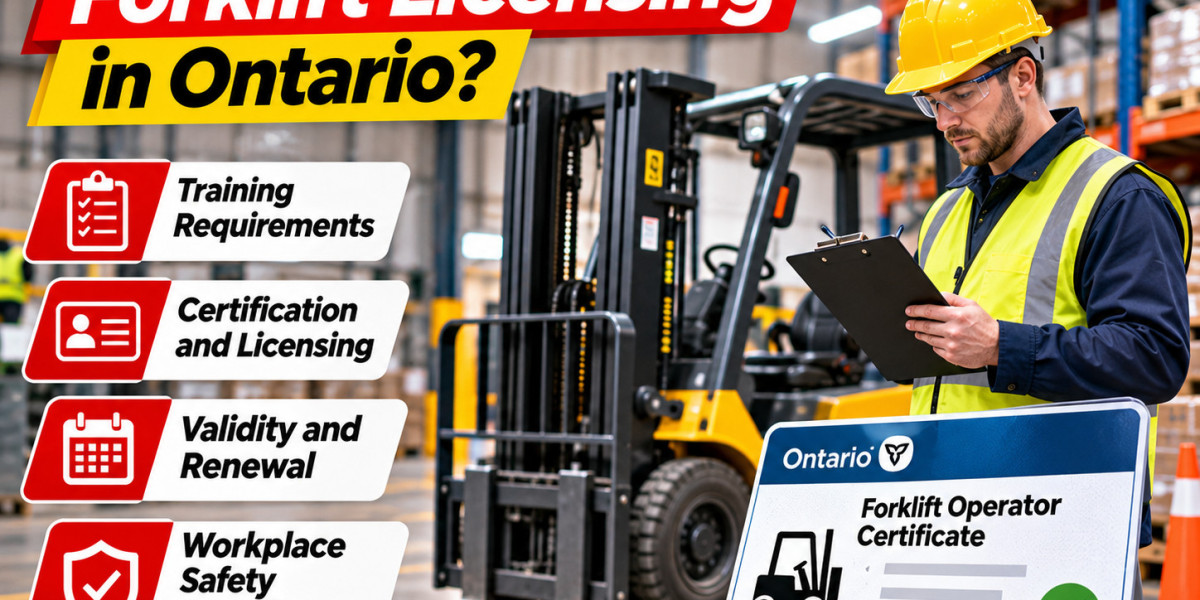

Forklift operators play an essential role in warehouses, manufacturing facilities, distribution centres, and other industrial workplaces across Ontario. Workers interested in Reach Truck Training often have questions about licensing requirements, certification, and the qualifications needed to operate powered lifting equipment. Although forklift certification is commonly discussed as a licensing process, Ontario does not issue a government forklift operator licence for ordinary workplace operations. Instead, employers must ensure that operators possess the appropriate knowledge, training, experience, and practical abilities to operate equipment safely. Understanding these requirements helps workers prepare for employment while supporting workplace safety.
Understanding Forklift Licensing Requirements in Ontario
Ontario's Occupational Health and Safety Act establishes general responsibilities for employers and workers regarding workplace safety. Regulation 851, which applies to industrial establishments, includes requirements concerning the safe operation of lifting devices.
Unlike a government-issued driver's licence, forklift operator certification generally comes from a training provider or employer. Training certificates document completed instruction and assessments, but they are not provincial licences.
The Ministry of Labour, Immigration, Training and Skills Development provides guidance explaining how employers should establish operator competency. This involves evaluating whether workers understand equipment characteristics, operating procedures, workplace hazards, and safety responsibilities.
A training certificate may support employment applications, but employers must independently determine whether individuals can operate their assigned equipment safely.
Important Forklift Training and Operator Requirements in Ontario
Several requirements and recommended practices help operators understand their responsibilities while working with powered lift trucks.
Operator Competency: Employers must ensure that workers operating lifting equipment possess the necessary knowledge, training, experience, and practical abilities.
Safety Instruction: Operators need appropriate information about equipment controls, load capacities, stability, inspections, and potential workplace hazards.
Practical Skills Assessment: Employers should verify that workers can safely perform essential operating tasks under actual or representative workplace conditions.
Equipment-Specific Knowledge: Different forklift models, including counterbalance trucks, reach trucks, and order pickers, may require additional instruction.
Workplace Safety Procedures: Operators must understand pedestrian routes, loading areas, storage arrangements, emergency procedures, and relevant workplace rules.
Training Documentation: Employers should maintain appropriate records of instruction, practical assessments, and operator competency.
These requirements demonstrate that safe forklift operation depends on proven ability rather than possessing a certificate alone.
How Forklift Operator Training and Workplace Evaluations Work in Ontario
Completing Forklift Safety Training
Forklift training typically begins with theoretical instruction covering equipment operation, workplace hazards, and occupational safety responsibilities.
Participants learn about forklift stability, load handling, safe travelling practices, and equipment inspections. Training programs may include classroom lessons, online theory modules, or a combination of instructional methods.
Practical instruction remains important because understanding written safety information does not automatically establish operating competence.
Training providers may issue certificates after participants successfully complete their course requirements. These certificates confirm program completion rather than granting government authorization to operate forklifts.
Demonstrating Practical Operating Competency
Practical evaluations help determine whether operators can apply safety knowledge while handling equipment.
Qualified evaluators may observe pre-operational inspections, steering, load positioning, lifting procedures, reversing, parking, and pedestrian awareness.
Operators should demonstrate appropriate control of the specific equipment they are expected to use.
Additional instruction may be necessary for workers who struggle with equipment handling or encounter unfamiliar operating conditions.
Receiving Employer Authorization
Employers are responsible for establishing whether individual workers are competent to operate powered lift trucks within their facilities.
An operator holding a certificate from an external training organization may still require workplace-specific instruction and evaluation.
Employers may establish internal authorization procedures documenting which employees can operate particular equipment.
Such authorization reflects the employer's competency assessment and workplace responsibilities. It should not be confused with a government-issued forklift licence.
Do Forklift Training Certificates Expire in Ontario?
Ontario does not establish one universal expiry date for every forklift training certificate. Training providers may specify validity periods according to their programs, while employers may establish refresher training schedules.
CSA B335 provides recognized safety guidance concerning lift truck training, evaluation, and periodic retraining. Three-year retraining intervals are commonly associated with this standard.
However, recommendations contained in industry standards should not automatically be described as universal statutory certificate expiry requirements.
Changes in equipment, workplace conditions, or operator performance may justify additional training regardless of the certificate date.
Why Workplace-Specific Training Remains Important
Operating conditions differ significantly between industrial facilities. Narrow warehouse aisles, elevated storage systems, pedestrian traffic, and loading docks introduce different hazards.
An operator experienced with one forklift model may need additional instruction to operate another type safely.
Employers should assess these differences and provide appropriate guidance to maintain safe equipment handling practices.
Conclusion
Forklift licensing in Ontario is primarily about establishing operator competency rather than obtaining a government-issued licence. Training certificates provide useful evidence of completed instruction, but they do not replace employer responsibility for workplace safety.
Operators should complete suitable training, demonstrate practical abilities, and follow workplace-specific procedures. Employers must establish competency and provide necessary instruction to support safe forklift operations throughout their facilities.